.
Free delivery for orders over $150 except DG chemicals* & Rural areas.
$ All Prices are in New Zealand Dollars

MICROSCOPE [Monocular]: M-100-FL with spare accessories

Price range: $ 4.50 through $ 331.80 excl. GST

MICROSCOPE [Monocular]: M-100-FL, with accessories

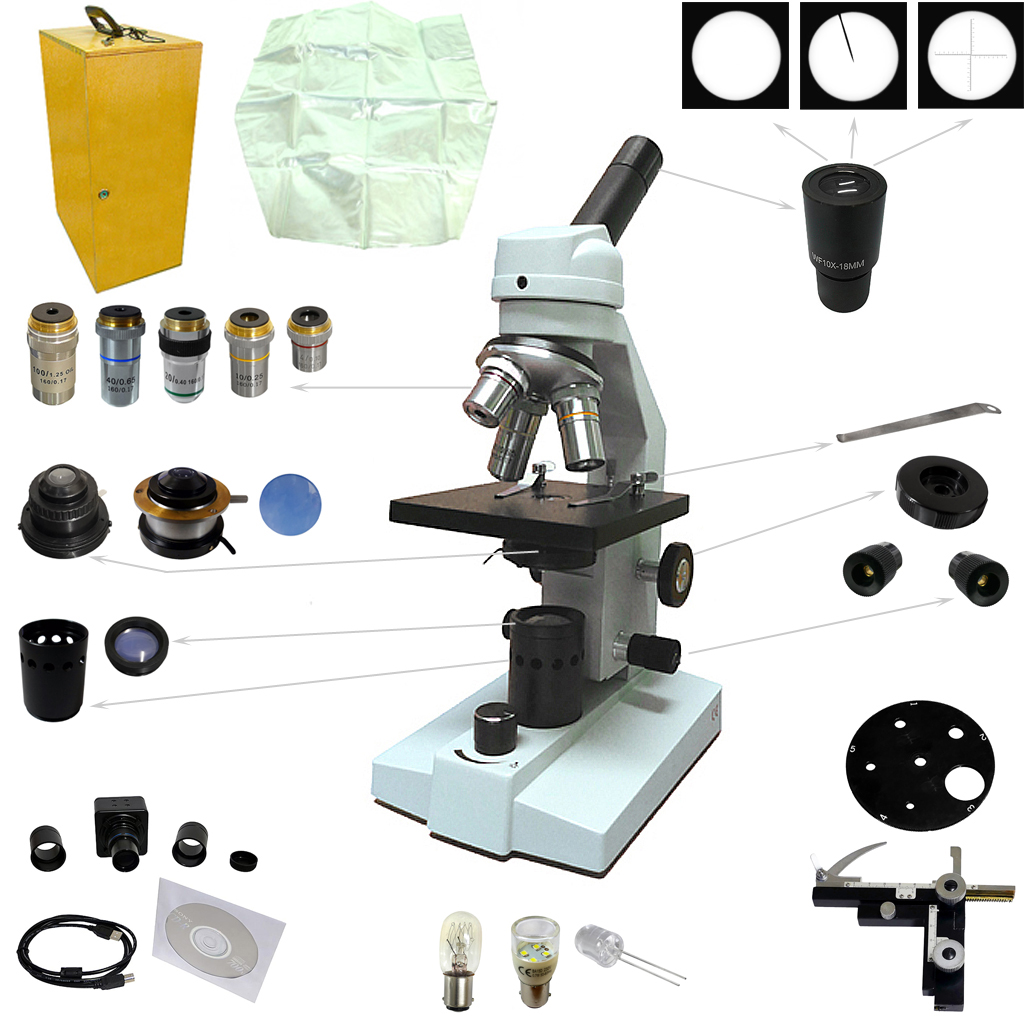
•  This M-100-FL Microscope model now has LED illumination and a modern design for senior student use.
•  Locked-on eyepiece and stage clips to prevent their loss.
•  Has a built-in illuminator in base.
•  FEATURES:
–  LED light source inclined eye-tube 360º degrees rotatable,
–  Coarse fine focusing controls with safety focus stop,
–  Sub-stage condenser with revolving disc diaphragm,
–  Objectives 4x, 10x, 40x (sprung),
–  Wide-field eyepiece 10x (removable).
•  Spare parts available include: Eyepieces  |  Objectives: 4X – 10X – 20X – 40X – 100X  |  Mechanical stage  |  Immersion oil  |  LED Lamps  |  Tungsten LED  |  Dust cover  |  Focus knobs  |  Abbe condensers  |  Disc diaphragm
•  View other Microscope related options.

SKU: MICROSCOPE-monocular-m-100-fl Categories: ,

Got a question?

We can answer any questions you have about MICROSCOPE [Monocular]: M-100-FL with spare accessories

This field is for validation purposes and should be left unchanged.
MICROSCOPE [Monocular]: M-100-FL with spare accessories

•  This M-100-FL Microscope model now has LED illumination and a modern design for senior student use.
•  Locked-on eyepiece and stage clips to prevent their loss.
•  Has a built-in illuminator in base.
•  FEATURES:
–  LED light source inclined eye-tube 360º degrees rotatable,
–  Coarse fine focusing controls with safety focus stop,
–  Sub-stage condenser with revolving disc diaphragm,
–  Objectives 4x, 10x, 40x (sprung),
–  Wide-field eyepiece 10x (removable).
•  Spare parts available include: Eyepieces  |  Objectives: 4X - 10X - 20X - 40X - 100X  |  Mechanical stage  |  Immersion oil  |  LED Lamps  |  Tungsten LED  |  Dust cover  |  Focus knobs  |  Abbe condensers  |  Disc diaphragm
•  View other Microscope related options.

(Wikipedia:.."...A microscope [M] (from Ancient Greek μικρός (mikrós) 'small' and σκοπέω (skopéō) 'to look (at); examine, inspect') is a laboratory instrument used to examine objects that are too small to be seen by the naked eye. Microscopy is the science of investigating small objects and structures using a microscope. Microscopic means being invisible to the eye unless aided by a [M] .

There are many types of [M] , and they may be grouped in different ways. One way is to describe the method an instrument uses to interact with a sample and produce images, either by sending a beam of light or electrons through a sample in its optical path, by detecting photon emissions from a sample, or by scanning across and a short distance from the surface of a sample using a probe. The most common [M] (and the first to be invented) is the optical [M] , which uses lenses to refract visible light that passed through a thinly sectioned sample to produce an observable image. Other major types of [M] are the fluorescence [M] , electron [M] (both the transmission electron [M] and the scanning electron [M] ) and various types of scanning probe [M] .[1]...")

[Got more questions? Email us your query.] | [Home Page]

Additional information

Description

, , , , , , , , , , , , , , , , , , , , , , , , , , , , , , , , , , , , , , , , ,