.
Free delivery for orders over $150 except DG chemicals* & Rural areas.
$ All Prices are in New Zealand Dollars

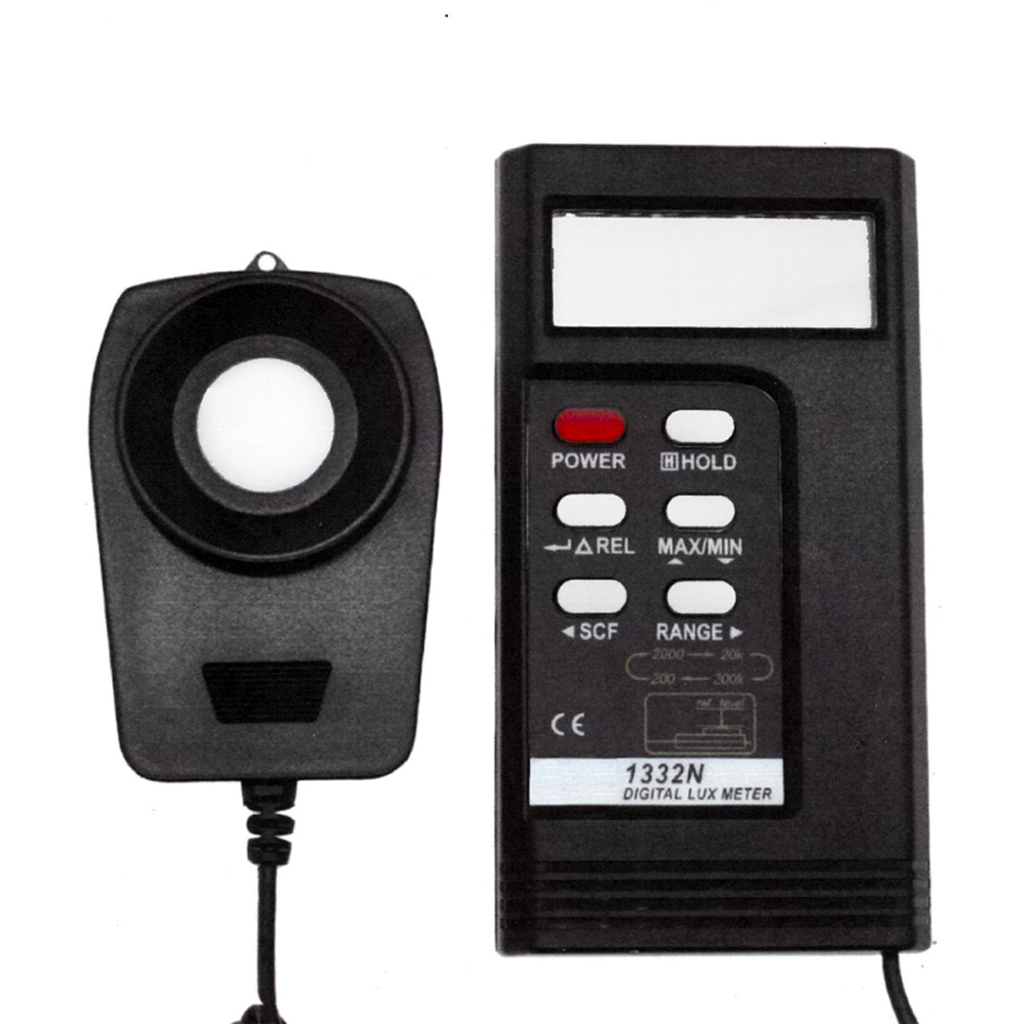
LIGHT METER [Lux]: Digital

$ 319.00 excl. GST

•  This digital illuminance Light Meter measures light levels ranging from 0.1 Lux to 200,000 Lux.
•  Records from zero to sunshine light levels making it very handy for the Biology Department.
•  Accurate and instant fast reading response time.
•  Spectral sensitivity close to CIE photopic curve.
•  Spectral correction actor function SCF (include LED).
•  Cosine angular corrected. Has lead reading data hold function.
•  Relative value comparison function. Maximum/Minimum recording function.
•  User calibration function (CAL).
•  Analogue output function.

•  SPECIFICATIONS:
–  Display: 3½ digit LCD display.
–  Overall Display Range: Highest digit of [1] is displayed.)
–  Measuring Range: 200 / 2000 / 20000 / 200000 Lux
(1Lux =  0.0929 Footcandle) (1 Footcandle = 10.76 Lux)
–  Resolution: 0.1 Lux.
–  Accuracy: +-3% rdg+-10dgts (<10,000 Lux) calibrated to standard incandescent lamp, 2856°K.
–  Accuracy: +-4% rdg+-10dgts (>10,000 Lux) calibrated to standard incandescent lamp, 2856°K.
–  Temperature Characteristics: +- 0.1% / °C (degrees Celsius).
–  Measuring Rate: approximately 2.0 time/sec
–  Operating Temperature + Humidity: 0°C ~ 40°C (degrees Celsius). (0% ~ 70% RH)
–  Storage Temperature + Humidity: -10°C to 60°C (degrees Celsius). (0% to 70% RH)
–  Power Source: 1x 9-Volt Battery
–  Battery Life (typical): 500 hours (carbon zinc)
–  Photosensor: Silicon photodiodes.
–  Photosensor: Lead length 150cm approx.
–  Photosensor Dimensions: 105 x 60 x 30mm LxWxH
–  Dimensions: 135 x 72 x 33mm (LxWxH)
–  Weight: 250g
–  Accessories supplied: Instruction manual  |  Carrying case  |  9V Battery
(Note: *The 200,000 Lux range is not found in all Lux meters. Some being offered to schools only measure up to 50,000 Lux – cannot be used to measure outside light levels.)

In stock (can be backordered)

SKU: FTH1564 Categories: , ,

Got a question?

We can answer any questions you have about LIGHT METER [Lux]: Digital

This field is for validation purposes and should be left unchanged.
LIGHT METER [Lux]: Digital

•  This digital illuminance Light Meter measures light levels ranging from 0.1 Lux to 200,000 Lux.
•  Records from zero to sunshine light levels making it very handy for the Biology Department.
•  Accurate and instant fast reading response time.
•  Spectral sensitivity close to CIE photopic curve.
•  Spectral correction actor function SCF (include LED).
•  Cosine angular corrected. Has lead reading data hold function.
•  Relative value comparison function. Maximum/Minimum recording function.
•  User calibration function (CAL).
•  Analogue output function.

•  SPECIFICATIONS:
-  Display: 3½ digit LCD display.
-  Overall Display Range: Highest digit of [1] is displayed.)
-  Measuring Range: 200 / 2000 / 20000 / 200000 Lux
(1Lux =  0.0929 Footcandle) (1 Footcandle = 10.76 Lux)
-  Resolution: 0.1 Lux.
-  Accuracy: +-3% rdg+-10dgts (<10,000 Lux) calibrated to standard incandescent lamp, 2856°K.
-  Accuracy: +-4% rdg+-10dgts (>10,000 Lux) calibrated to standard incandescent lamp, 2856°K.
-  Temperature Characteristics: +- 0.1% / °C (degrees Celsius).
-  Measuring Rate: approximately 2.0 time/sec
-  Operating Temperature + Humidity: 0°C ~ 40°C (degrees Celsius).(0% ~ 70% RH)
-  Storage Temperature + Humidity: -10°C to 60°C (degrees Celsius). (0% to 70% RH)
-  Power Source: 1x 9-Volt Battery
-  Battery Life (typical): 500 hours (carbon zinc)
-  Photosensor: Silicon photodiodes.
-  Photosensor: Lead length 150cm approx.
-  Photosensor Dimensions: 105 x 60 x 30mm LxWxH
-  Dimensions: 135 x 72 x 33mm (LxWxH)
-  Weight: 250g
-  Accessories supplied: Instruction manual  |  Carrying case  |  9V Battery
(Note: *The 200,000 Lux range is not found in all Lux meters. Some being offered to schools only measure up to 50,000 Lux – cannot be used to measure outside light levels.)

(Wikipedia excerpt: ..."...Light, visible light, or visible radiation is electromagnetic radiation that can be perceived by the human eye.[1] Visible light spans the visible spectrum and is usually defined as having wavelengths in the range of 400–700 nanometres (nm), corresponding to frequencies of 750–420 terahertz. The visible band sits adjacent to the infrared (with longer wavelengths and lower frequencies) and the ultraviolet (with shorter wavelengths and higher frequencies), called collectively optical radiation.[2][3]

In physics, the term "light" may refer more broadly to electromagnetic radiation of any wavelength, whether visible or not.[4][5] In this sense, gamma rays, X-rays, microwaves and radio waves are also light. The primary properties of light are intensity, propagation direction, frequency or wavelength spectrum, and polarization. Its speed in vacuum, 299792458 m/s, is one of the fundamental constants of nature.[6] All electromagnetic radiation exhibits some properties of both particles and waves. Single, massless elementary particles, or quanta, of light called photons can be detected with specialized equipment; phenomena like interference are described by waves. Most everyday interactions with light can be understood using geometrical optics; quantum optics, is an important research area in modern physics....")

[Got more questions? Email us your query.] | [Home Page]