Account

ELECTROPHORESIS: Variety, Tank, Kits
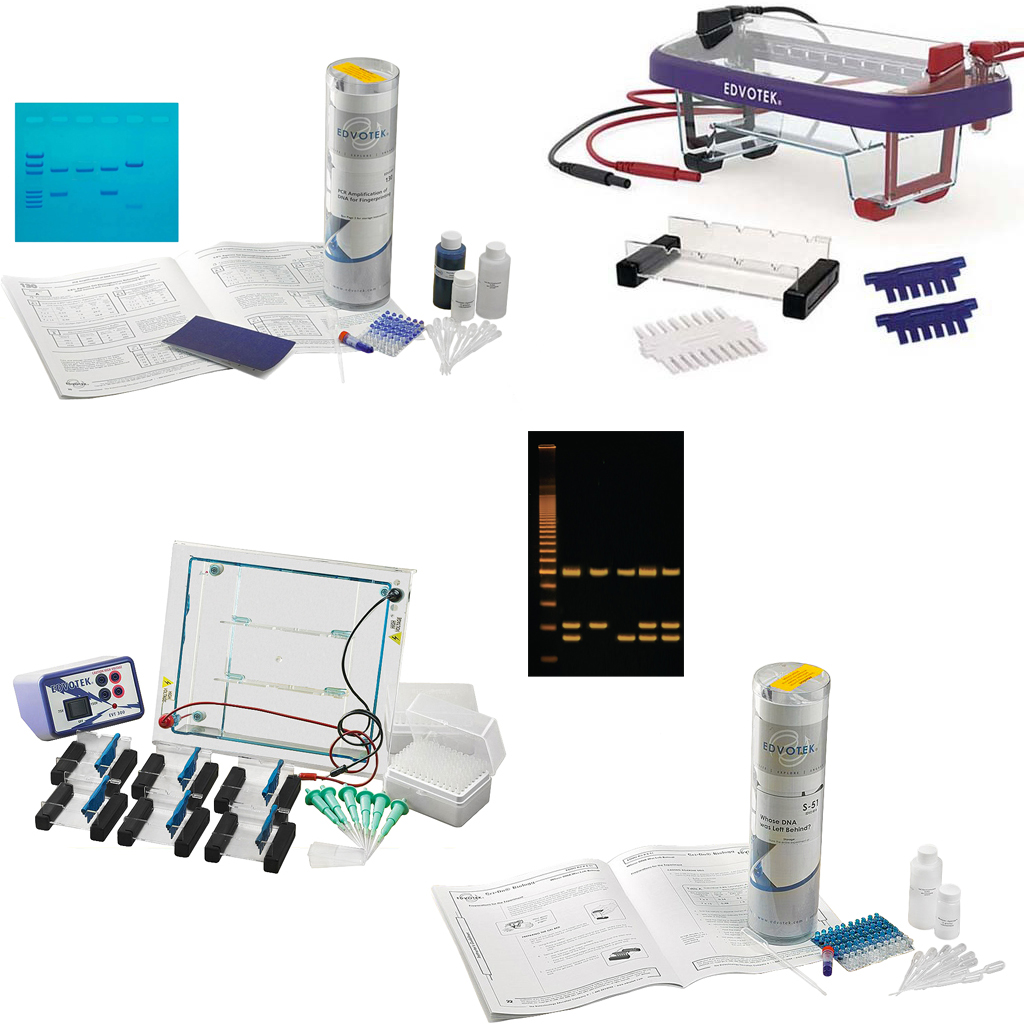
A variety of 5x kits for use in science laboratory.
Gel electrophoresis is a technique for the separation and charge-based analysis of macromolecules (DNA, RNA, and proteins) and their fragments. In biochemistry and molecular biology, it is used to separate a population of DNA and RNA fragments by length, to estimate the size of DNA and RNA fragments, or to separate proteins by charge. Nucleic acid molecules are separated by passing negatively charged molecules through a matrix of agarose or other substances using an electric field. Because shorter molecules migrate through the pores of the gel more easily than longer molecules, shorter molecules move faster and migrate further. This process is known as sieving. The charge in agarose separates proteins because the pores of the gel are too tiny to filter proteins. Nanoparticle separation is also possible using gel electrophoresis. During electrophoresis, the movement of a charged particle in an electrical current, gel electrophoresis uses a gel as an anticonvective medium or sieve medium. Gels suppress the thermal convection induced by the application of the electric field and can also act as a sieve medium, slowing the passage of molecules; gels can also serve to retain the separation so that a post-electrophoresis stain can be applied. DNA Gel electrophoresis is typically used for analytical purposes, frequently following amplification of DNA via polymerase chain reaction (PCR). However, it can also be used as a preparative technique prior to the use of other techniques such as mass spectrometry, RFLP, PCR, cloning, DNA sequencing, or Southern blotting for further characterization. Electrophoresis is a method for separating molecules according to their size. Using an electric field, it is possible to transport molecules (such as DNA) over an agarose or polyacrylamide gel. At one end of the electric field is a negative charge, which pushes the molecules through the gel, and at the other end is a positive charge, which pulls the molecules through the gel.
The sorted molecules are dispensed into a well within the gel substance. The gel is placed inside an electrophoresis chamber, which is then wired to a power supply. When an electric field is provided, the larger molecules travel through the gel more slowly than the smaller molecules. On the gel, the different sized molecules form separate bands. Gel refers to the matrix utilized to hold and subsequently separate the target molecules in this instance. In the majority of instances, the gel is a cross-linked polymer whose composition and porosity are selected based on the precise mass and chemical composition of the target to be examined. When separating proteins or tiny nucleic acids (DNA, RNA, or oligonucleotides), the gel is often made of various concentrations of acrylamide and a cross-linker, resulting in polyacrylamide mesh networks of varying sizes. When separating nucleic acids with more than a few hundred bases, agarose is the recommended matrix. In both instances, the gel produces a porous, solid matrix. Acrylamide, unlike polyacrylamide, is a neurotoxic and must be handled with the necessary precautions to prevent poisoning. Agarose consists of long unbranched chains of uncharged carbohydrate without cross-links, resulting in a gel with wide pores that allows separation of macromolecules and macromolecular complexes.