
.
Free delivery for orders over $150 except DG chemicals* & Rural areas.
$ All Prices are in New Zealand Dollars

CONDUCTIVITY RINGS

Price range: $ 40.20 through $ 53.00 excl. GST

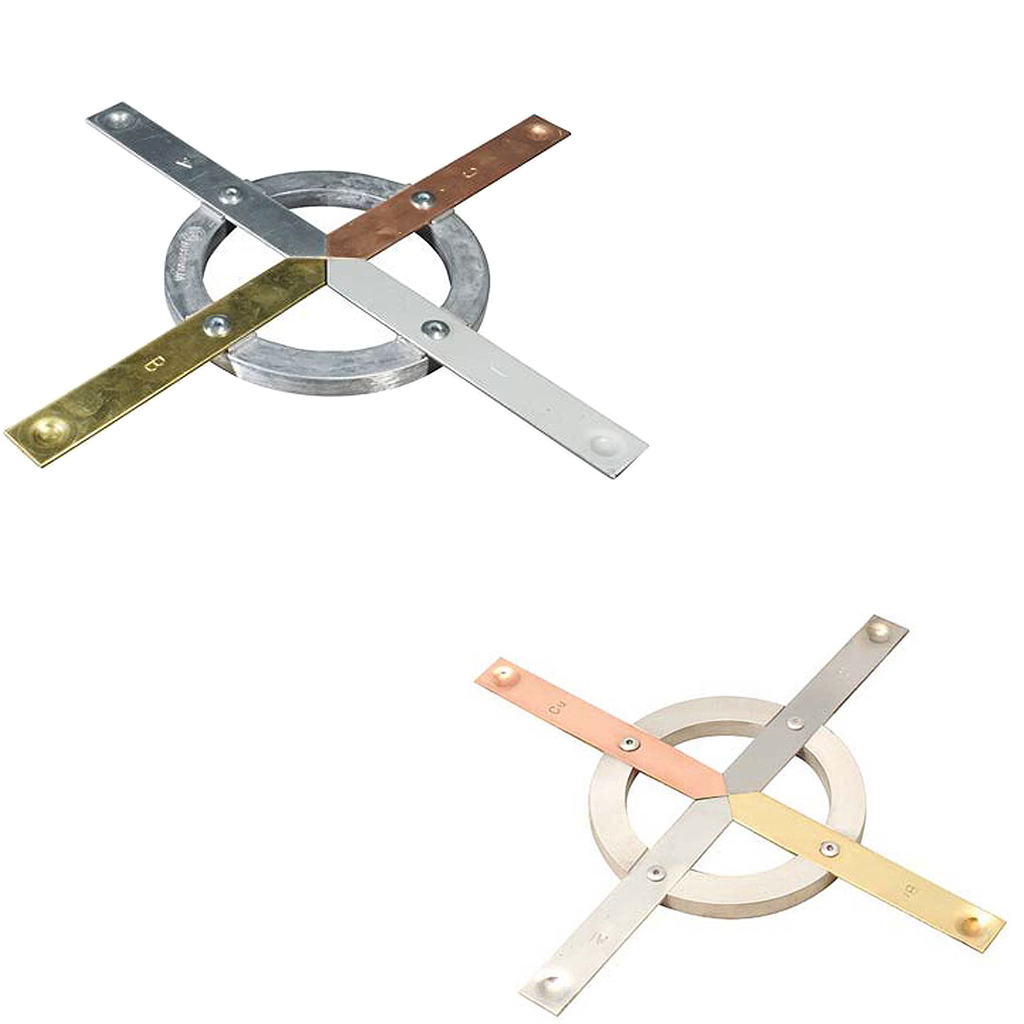
•  This Conductivity Ring demonstrates very simply the difference in heat conductivity between 4x different metals – : Iron, Copper, Brass and Aluminium.
•  Each metal is embossed with either an ‘Fe’ (iron), ‘Cu’ (copper), ‘Br’ (brass) and an ‘Al’ (aluminium) respectively to identify them.
•  The four 20 x 125mm metal strips are attached to a outside Ø 113mm aluminium ring.
•  At the outer end of each metal strip is a round depression in which a piece of wax about the size of a pea is placed.
•  When a point heat source, e.g. Bunsen burner or spirit lamp, is placed where the metals meet in the centre of the ring heat is conducted along each metal strip.
•  By observing the differing time it takes to melt the wax the heat conductivity of each metal can be compared.
SKU: CONDUCTIVITY-RINGS Categories: , ,

Got a question?

We can answer any questions you have about CONDUCTIVITY RINGS

This field is for validation purposes and should be left unchanged.
CONDUCTIVITY RINGS

•  This Conductivity Ring demonstrates very simply the difference in heat conductivity between 4x different metals – : Iron, Copper, Brass and Aluminium.
•  Each metal is embossed with either an ‘Fe’ (iron), ‘Cu’ (copper), ‘Br’ (brass) and an ‘Al’ (aluminium) respectively to identify them.
•  The four 20 x 125mm metal strips are attached to a outside Ø 113mm aluminium ring.
•  At the outer end of each metal strip is a round depression in which a piece of wax about the size of a pea is placed.
•  When a point heat source, e.g. Bunsen burner or spirit lamp, is placed where the metals meet in the centre of the ring heat is conducted along each metal strip.
•  By observing the differing time it takes to melt the wax the heat conductivity of each metal can be compared.
(Wikipedia excerpt: .."...In heat transfer, the thermal conductivity of a substance, k, is an intensive property that indicates its ability to conduct heat. For most materials, the amount of heat conducted varies (usually non-linearly) with temperature.[1]
Thermal conductivity is often measured with laser flash analysis. Alternative measurements are also established.

Mixtures may have variable thermal conductivities due to composition. Note that for gases in usual conditions, heat transfer by advection (caused by convection or turbulence for instance) is the dominant mechanism compared to conduction.
This table shows thermal conductivity in SI units of watts per metre-kelvin (W·m−1·K−1). Some measurements use the imperial unit BTUs per foot per hour per degree Fahrenheit (1 BTU h−1 ft−1 F−1 = 1.728 W·m−1·K−1).[2]...")

[Got more questions? Email us your query.] | [Home Page]

Additional information

Description

,

You may also like…