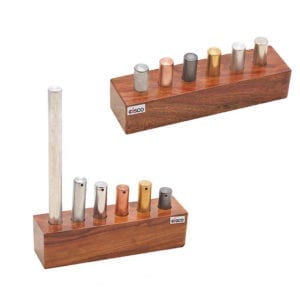
COMPOUND BARS
Price range: $ 9.90 through $ 15.60 excl. GST
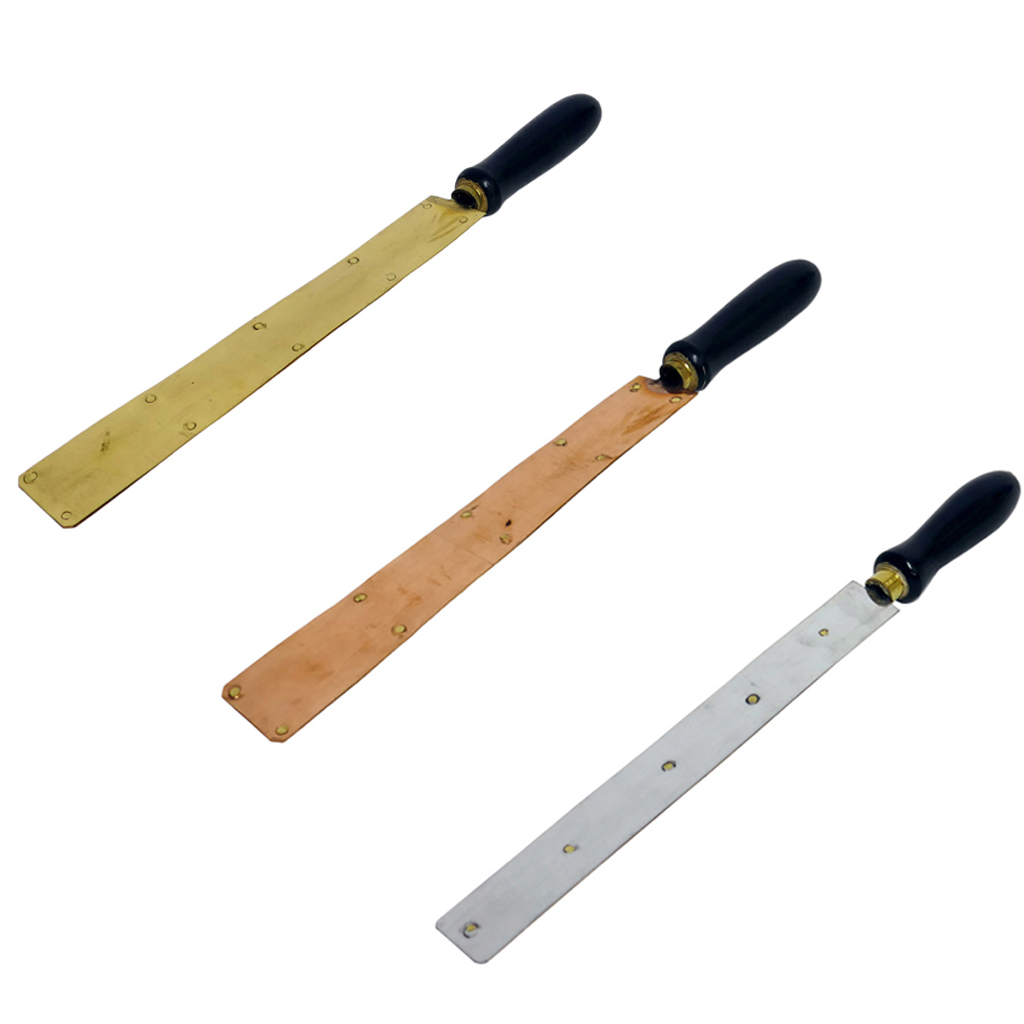
• These Compound Bars demonstrates curvature caused by unequal expansion of two dissimilar metals.
• Metals riveted together.
• When heat is applied bar bends.
• Dimensions: 220 x 30mm (330mm including wooden handle).
• Do not use point source heat as this can damage the compound bars.
• NOTE: *Fishtail burner head or similar required to be fitted to bunsen for heating.
COMPOUND BARS
• These Compound Bars demonstrates curvature caused by unequal expansion of two dissimilar metals.
• Metals riveted together.
• When heat is applied bar bends.
• Dimensions: 220 x 30mm (330mm including wooden handle).
• Do not use point source heat as this can damage the compound bars.
• NOTE: *Fishtail burner head or similar required to be fitted to bunsen for heating.
(Wikipedia excerpt: .."...The thermal conductivity of a material is a measure of its ability to conduct heat. It is commonly denoted by k {\displaystyle k}, λ {\displaystyle \lambda }, or κ {\displaystyle \kappa } and is measured in W·m−1·K−1.
Heat transfer occurs at a lower rate in materials of low thermal conductivity than in materials of high thermal conductivity. For instance, metals typically have high thermal conductivity and are very efficient at conducting heat, while the opposite is true for insulating materials such as mineral wool or Styrofoam. Correspondingly, materials of high thermal conductivity are widely used in heat sink applications, and materials of low thermal conductivity are used as thermal insulation. The reciprocal of thermal conductivity is called thermal resistivity.....")
Additional information
| Item Range Size |
|---|