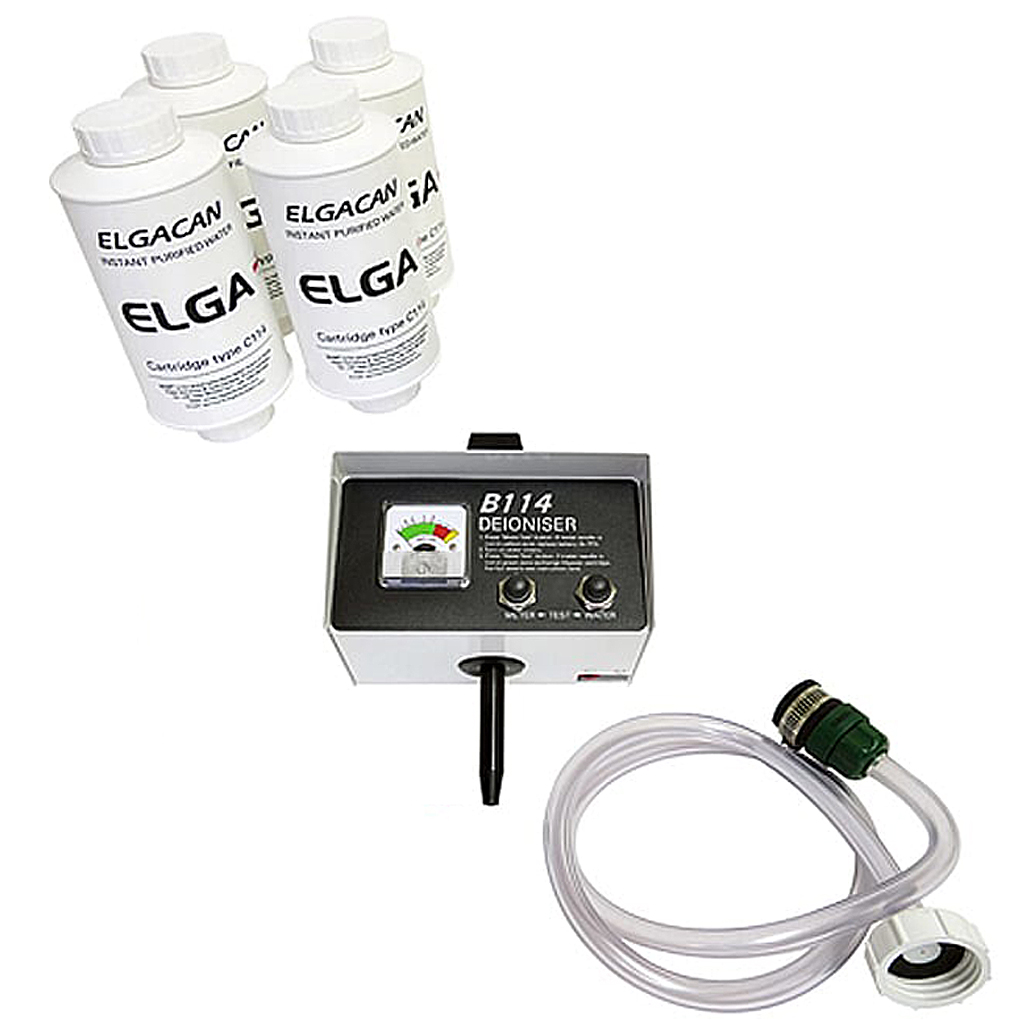
WATER DEIONISER: Elgastat unit apparatus
Price range: $ 188.00 through $ 1,801.00 excl. GST
• This Water Deioniser uses disposable ‘Elgacans’ where the Elgastat is a wall mounted dispenser incorporating a purity meter.
• Connect to any cold water tap and purified water can be drawn until ion exchange resins are shown to be exhausted.
• Max. input pressure: 0.63 Bar (10 psi)
• Max. flow rate: 30 litres/hour
• Water purity: 1-10Mohm/cm 1.0 – 0.1μS/cm
• Resin volume: 0.57 litres
• Mass: 2.2kg
• Size: 380 x 180 x 152mm.
• Supplied complete with 4x ‘Elgacans’, but WITHOUT battery.
WATER DEIONISER: Elgastat Unit Apparatus
• This Water Deioniser uses disposable ‘Elgacans’ where the Elgastat is a wall mounted dispenser incorporating a purity meter.
• Connect to any cold water tap and purified water can be drawn until ion exchange resins are shown to be exhausted.
• Max. input pressure: 0.63 Bar (10 psi)
• Max. flow rate: 30 litres/hour
• Water purity: 1-10Mohm/cm 1.0 – 0.1μS/cm
• Resin volume: 0.57 litres
• Mass: 2.2kg
• Size: 380 x 180 x 152mm.
• Supplied complete with 4x ‘Elgacans’, but WITHOUT battery.
(Wikipedia excerpt: "...Deionized water (DI water, DIW or de-ionized water), often synonymous with demineralized water / DM water,[4] is water that has had almost all of its mineral ions removed, such as cations like sodium, calcium, iron, and copper, and anions such as chloride and sulfate. Deionization is a chemical process that uses specially manufactured ion-exchange resins, which exchange hydrogen and hydroxide ions for dissolved minerals, and then recombine to form water. Because most non-particulate water impurities are dissolved salts, deionization produces highly pure water that is generally similar to distilled water, with the advantage that the process is quicker and does not build up scale.
However, deionization does not significantly remove uncharged organic molecules, viruses, or bacteria, except by incidental trapping in the resin. Specially made strong base anion resins can remove Gram-negative bacteria. Deionization can be done continuously and inexpensively using electrodeionization.
Three types of deionization exist: co-current, counter-current, and mixed bed....")
Additional information
| Description |
|---|