.
Free delivery for orders over $150 except DG chemicals* & Rural areas.
$ All Prices are in New Zealand Dollars

Stem Education ‘Horizon’ | ENERGY MONITOR

$ 358.00 excl. GST

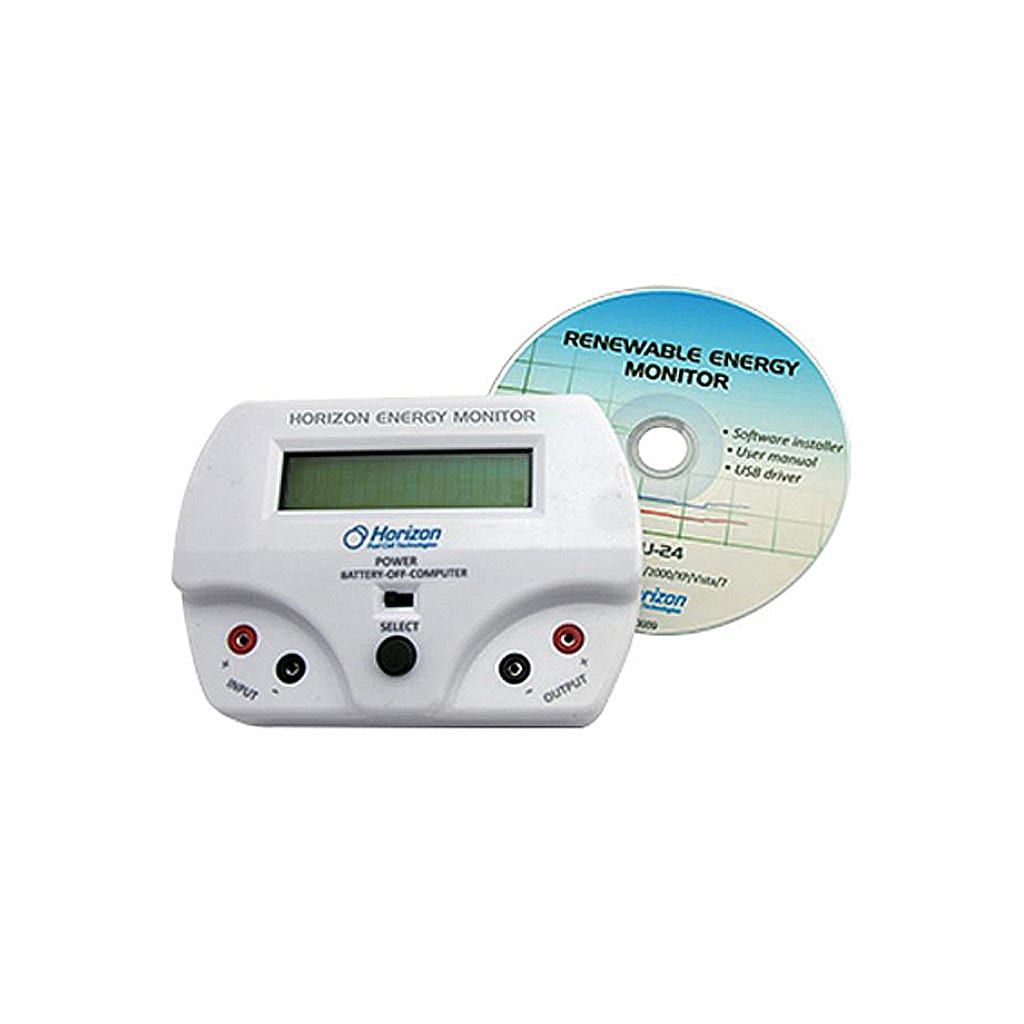
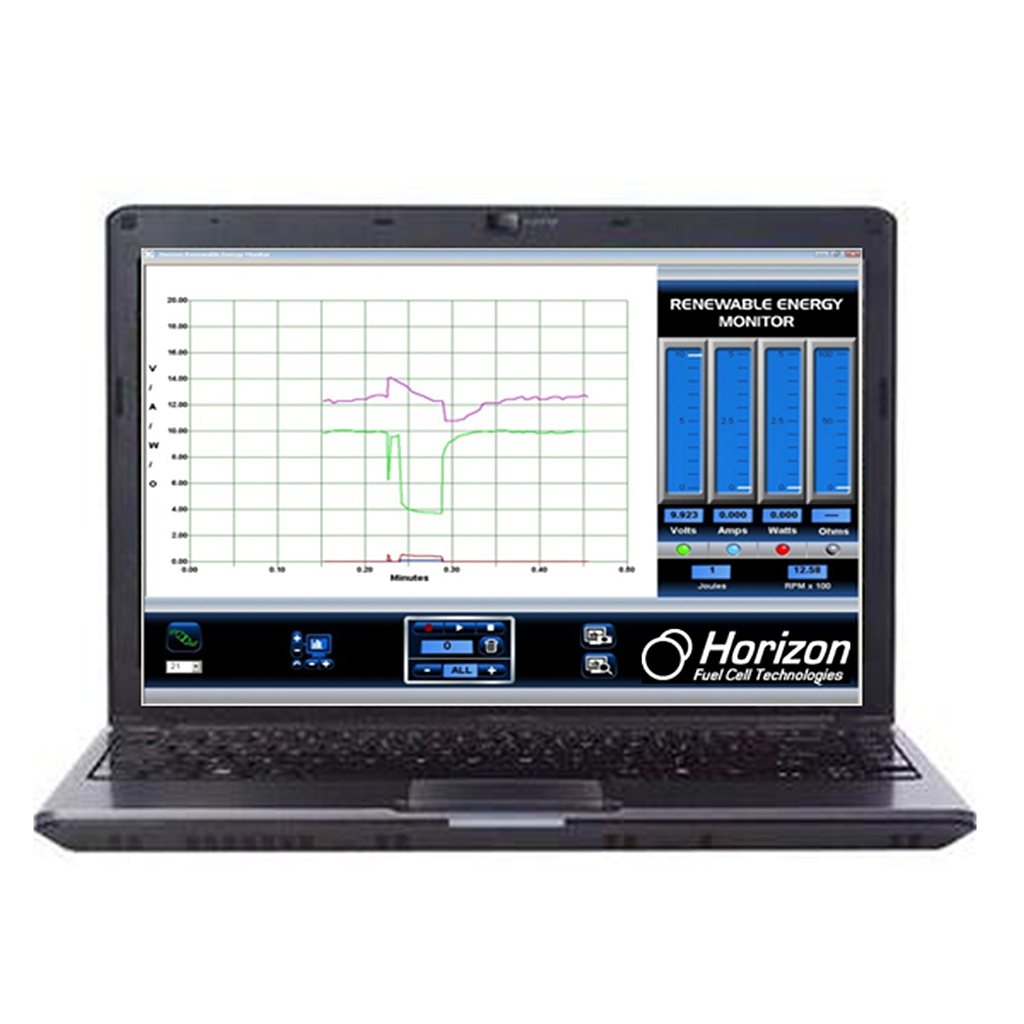
►  This Stem Education renewable ENERGY MONITOR is an evaluation monitoring device with PC measurement software to graphically display performance characteristics on its 2 line LCD screen or your Windows computer.

•  Developed to avoid multimeter confusing setup and cumbersome computations that provide an immediate, graphical way for recording data directly with no formulas and nothing to calculate.
•  Battery operated and comes with a USB port so it can also be used with or without a computer – indoors or outdoors –
•  Make direct solar and wind measurements, numerous experiments and evaluation activities for hydrogen fuel cells, miniature wind turbine kits, and solar panels.
•  These are now quantifiable in real time for voltage, current, power, joules, resistance, and even wind turbine RPM speed – all viewable and recordable at the same time !
•  Helps bring lab and field experiments back into the classroom, making it the ideal tool to complement the Wind to Hydrogen Science Kit, the Renewable Energy Science Kit and the Wind Energy Science Kit.

Features:
•  Compare voltage, current, resistance and RPM.
•  Use in place of voltmeter, ammeter or multimeter for all your electro-chemical experiments.
•  Compatible with any of Horizon’s science education kits.
•  Compatible with Windows OS, and Mac using Windows Parallel or Boot Camp.
•  Use indoor or outdoor, with or without a computer !
•  Export all data to Excel or CSV format.
•  Record a video of your experiments for playback and review.

Specifications:
Voltage: 0 to 28-volts/DC |  Current: 0 – 1A/DC |  Power: 0 to 28-watts |  Resistance: 0 to 999-Ohms |  Energy: 0 – 65535 Joules |  RPM: 200 – 2500.

Kit Contents:
ENERGY MONITOR (Data Logging Hardware) with LCD readout screen |  LCD screen shows: voltage (V,mV), current (A, mA), power (W, mW), |  RPM speed, resistance (Ohms), energy(joules) |  USB cable – 1 meter length |  CD-ROM with Horizon Data Acquisition software |  CD-ROM with complete renewable energy curriculum |  Flexible 2mm banana connecting leads for connecting to Horizon devices.

Experiments:
–  Compare voltage, current, resistance and RPM
–  Use in place of voltmeter, ammeter or multimeter for all your electro-chemical experiments.

[View ENERGY MONITOR pdf info: HNFCJJ-24-datasheet  or  HNFCJJ-24-user-manual ]

In stock (can be backordered)

SKU: HNFCJJ-24 Categories: ,
This field is for validation purposes and should be left unchanged.

Got a question?

We can answer any questions you have about Stem Education 'Horizon' | ENERGY MONITOR

Stem Education 'Horizon' | ENERGY MONITOR

•  This Stem Education renewable ENERGY MONITOR is an evaluation monitoring device with PC measurement software to graphically display performance characteristics on its 2 line LCD screen or your Windows computer. Useful in the science laboratory for Stem Education related demonstrations.

[View ENERGY MONITOR pdf info: HNFCJJ-24-datasheet  or  HNFCJJ-24-user-manual ]

[info]
WHY FUEL CELLS and HYDROGEN ?

► Fuel cells can be thought of as alternative energy devices.
They convert chemical energy into electrical energy.
Hydrogen fuel cells do this very cleanly, with no toxic emissions, and with a better efficiency.

Fuel cells do not generate energy out of thin air.
They use hydrogen.
Hydrogen is an outstanding carrier of energy.

► Hydrogen is non-toxic, renewable, easily obtained, and packed with energy.
When it combusts with oxygen, it turns into water.
This water can again be split into hydrogen and oxygen via electrolysis.

The generated hydrogen can be combusted once again, thus undergoing a limitless cycle without toxic emissions.
With a fuel cell, you can convert hydrogen into electric current without combustion.
Fossil fuels are converted into usable energy through combustion.

► The energy released during combustion is inherently difficult to capture and inefficient.
It also produces carbon dioxide, which cannot easily be converted back into a usable fuel.
A fossil fuel combustion engine at a power plant is only about 30 to 40% efficient.

This means it coverts only 30 to 40% of the energy in the fossil fuels to usable energy (electricity).
Engines in a car are even less efficient, and reach the level of 15 to 20% of efficiency.
Where does the rest of the energy go? It escapes as heat, vibration, and noise.

"STEM is an acronym for Science-Technology-Engineering-Math."

[Got more questions? Email us your query.] | [Home Page]