.
Free delivery for orders over $150 except DG chemicals* & Rural areas.
$ All Prices are in New Zealand Dollars

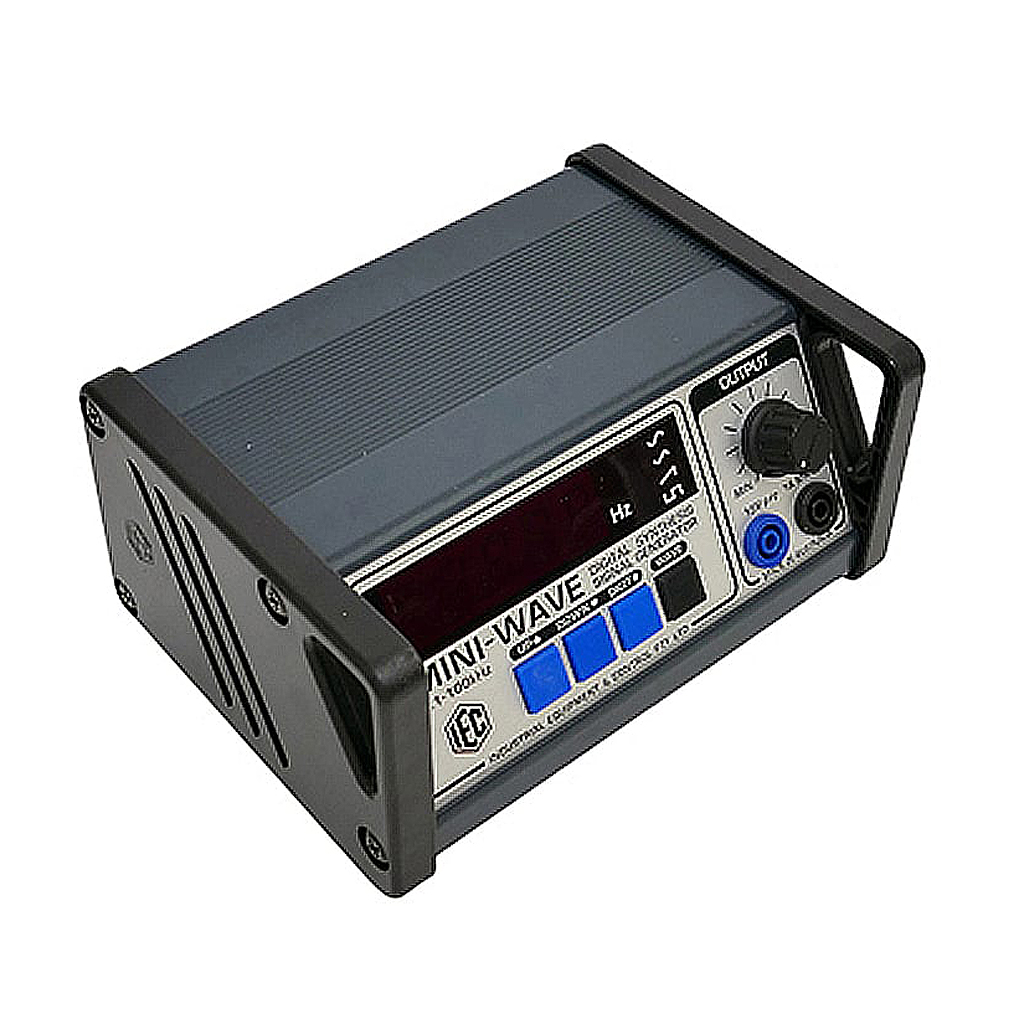
SIGNAL GENERATOR: Mini wave

$ 560.00 excl. GST

SIGNAL GENERATOR: Mini Wave

•  This compact signal generator provides waveforms of sine, square, triangle and sawtooth.
•  It is crystal locked, giving excellent stability, therefore the accuracy is extremely high (approx 0.01%).
•  Powered from 240-volts mains supply and delivers an adjustable output of 15-volts peak to peak or 5-volts/AC RMS.
•  The output can supply up to 1-amp into a load. Is current limited against overload.
•  With an inbuilt “Quick Set” system, this permits the fast setting of a preset frequency.
•  Resolution is 0.1Hz up to 10kHz. From 10kHz up to 100kHz, the resolution is 1 Hz.
•  Used for Kundt’s Apparatus, Ruben’s Tube,  audio and resonance experiments.
•  Demonstrates oscilloscope functions.
Out of stock. (can be backordered).

SKU: IEC1817 Categories: ,

Got a question?

We can answer any questions you have about SIGNAL GENERATOR: Mini wave

This field is for validation purposes and should be left unchanged.
SIGNAL GENERATOR: Mini Wave

•  This compact signal generator provides waveforms of sine, square, triangle and sawtooth.
•  It is crystal locked, giving excellent stability, therefore the accuracy is extremely high (approx 0.01%).
•  Powered from 240-volts mains supply and delivers an adjustable output of 15-volts peak to peak or 5-volts/AC RMS.
•  The output can supply up to 1-amp into a load. Is current limited against overload.
•  With an inbuilt “Quick Set” system, this permits the fast setting of a preset frequency.
•  Resolution is 0.1Hz up to 10kHz. From 10kHz up to 100kHz, the resolution is 1 Hz.
•  Used for Kundt’s Apparatus, Ruben’s Tube,  audio and resonance experiments.
•  Demonstrates oscilloscope functions.

(Wikipedia excerpt: ..."...A signal generator is one of a class of electronic devices that generates electrical signals with set properties of amplitude, frequency, and wave shape. These generated signals are used as a stimulus for electronic measurements, typically used in designing, testing, troubleshooting, and repairing electronic or electroacoustic devices, though it often has artistic uses as well. [1]

There are many different types of signal generators with different purposes and applications and at varying levels of expense. These types include function generators, RF and microwave signal generators, pitch generators, arbitrary waveform generators, digital pattern generators, and frequency generators. In general, no device is suitable for all possible applications.

A signal generator may be as simple as an oscillator with calibrated frequency and amplitude. More general-purpose signal generators allow control of all the characteristics of a signal. Modern general-purpose signal generators will have a microprocessor control and may also permit control from a personal computer. Signal generators may be free-standing self-contained instruments, or may be incorporated into more complex automatic test systems. ..")

[Got more questions? Email us your query.] | [Home Page]