.
Free delivery for orders over $150 except DG chemicals* & Rural areas.
$ All Prices are in New Zealand Dollars

ROCK TOOL: Obsidian arrowheads

$ 16.80 excl. GST

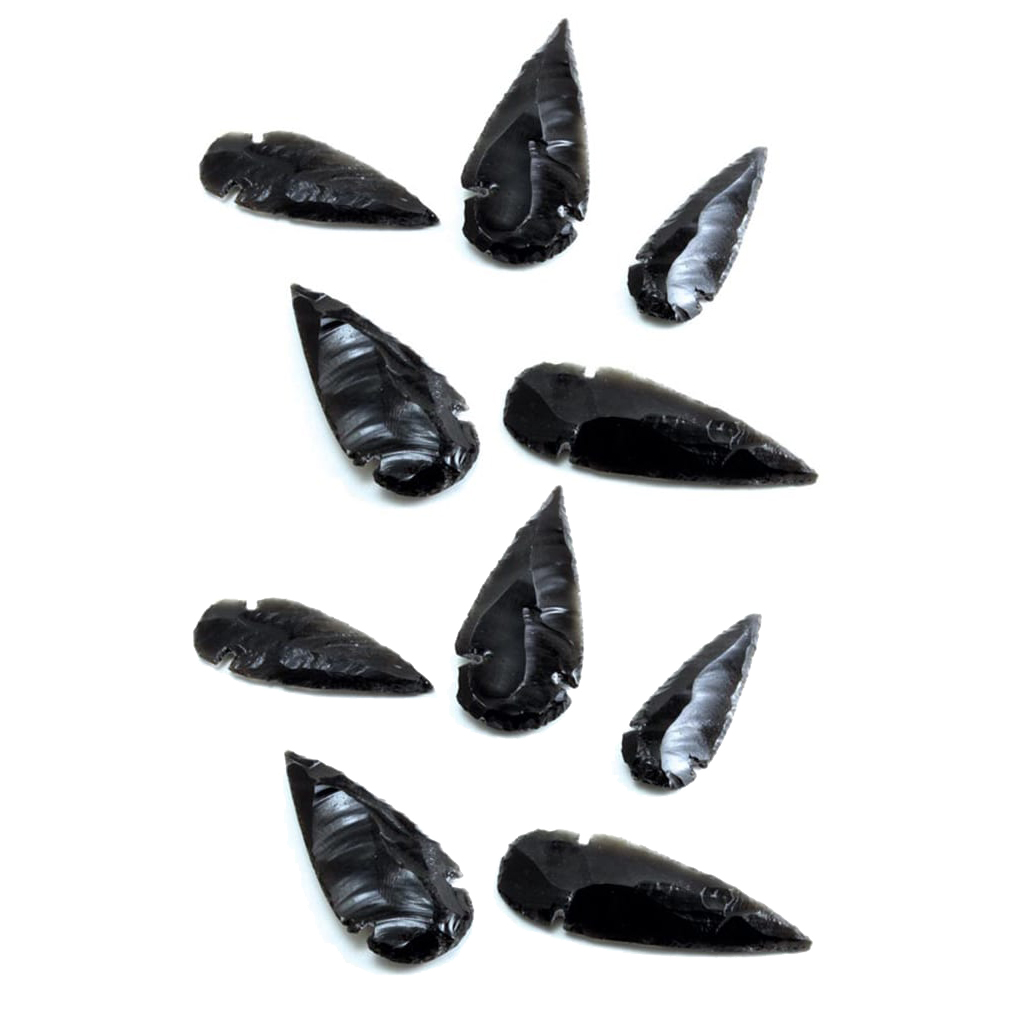
•  With this Rock Tool, students are always fascinated when something mundane like a rock is formed into something useful like an arrowhead.
•  These recently-made large arrowheads were hand-crafted from volcanic obsidian.
•  A great demonstration tool when teaching about Native Americans, igneous rocks, or man’s early use of tools.
•  Each arrowhead is unique and measures approximately 50 – 75mm long.
•  Sold in pack of 10.
•  (Caution: *Arrowheads are sharp.)

Out of stock. (can be backordered).

SKU: EI-RM200/10 Category:

Got a question?

We can answer any questions you have about ROCK TOOL: Obsidian arrowheads

This field is for validation purposes and should be left unchanged.
ROCK TOOL: Obsidian Arrowheads, Pack of 10

•  With this Rock Tool, students are always fascinated when something mundane like a rock is formed into something useful like an arrowhead.
•  These recently-made large arrowheads were hand-crafted from volcanic obsidian.
•  A great demonstration tool when teaching about Native Americans, igneous rocks, or man's early use of tools.
•  Each arrowhead is unique and measures approximately 50 – 75mm long.
•  Sold in pack of 10.
•  (Caution: *Arrowheads are sharp.)

(Wikipedia excerpt: .."...Obsidian (/əbˈsɪdi.ən, ɒb-/ əb-SID-ee-ən ob-)[5] is a naturally occurring volcanic glass formed when lava extruded from a volcano cools rapidly with minimal crystal growth. It is an igneous rock.[6] Produced from felsic lava, obsidian is rich in the lighter elements such as silicon, oxygen, aluminium, sodium, and potassium. It is commonly found within the margins of rhyolitic lava flows known as obsidian flows. These flows have a high content of silica, giving them a high viscosity. The high viscosity inhibits the diffusion of atoms through the lava, which inhibits the first step (nucleation) in the formation of mineral crystals. Together with rapid cooling, this results in a natural glass forming from the lava.[7]

Obsidian is hard, brittle, and amorphous; it therefore fractures with sharp edges. In the past, it was used to manufacture cutting and piercing tools, and it has been used experimentally as surgical scalpel blades.[8]...")

[Got more questions? Email us your query.] | [Home Page]


You may also like…