
.
Free delivery for orders over $150 except DG chemicals* & Rural areas.
$ All Prices are in New Zealand Dollars

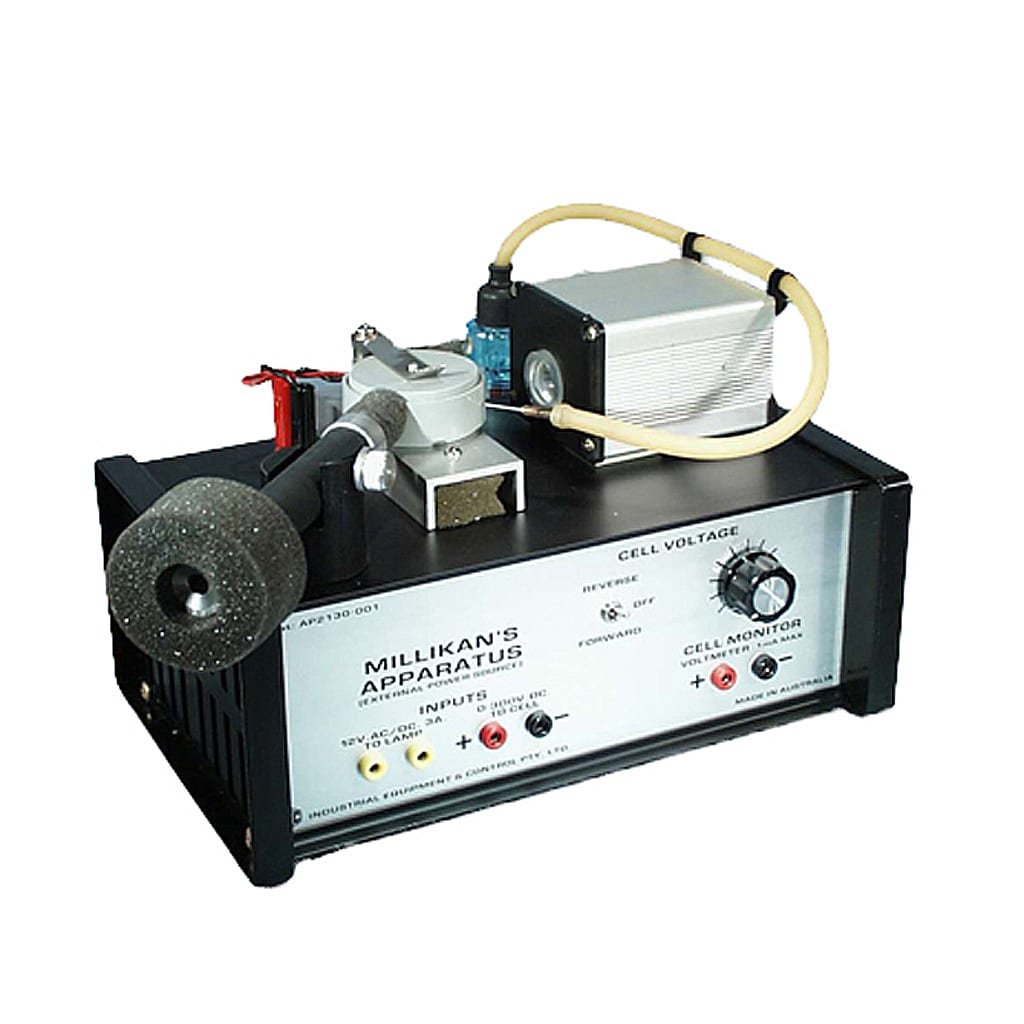
MILLIKANS APPARATUS: Brownian motion observation

$ 1,055.00 excl. GST

•  This Millikans Apparatus is designed for instant success in performing Millikan’s experiment of charged particles.
•  Brownian motion can also easily be observed.
•  With minimum of preparation the tiny particles are very easily seen and measurements taken.
•  Supplied complete with calibrated telescope, cell with viewing windows, atomizer and injection device, polarity reversing facility, voltage adjustment control and bottle of 1 micron dia. latex spheres.
•  Power supply required :  300-volts/DC at 1mA  and 12-volt/AC or DC at 3A.

Out of stock. (can be backordered).

SKU: IEC0288 Categories: ,

Got a question?

We can answer any questions you have about MILLIKANS APPARATUS: Brownian motion observation

This field is for validation purposes and should be left unchanged.
MILLIKANS APPARATUS: Brownian motion observation.

•  This Millikans Apparatus is designed for instant success in performing Millikan’s experiment of charged particles.
•  Brownian motion can also easily be observed.
•  With minimum of preparation the tiny particles are very easily seen and measurements taken.
•  Supplied complete with calibrated telescope, cell with viewing windows, atomizer and injection device, polarity reversing facility, voltage adjustment control and bottle of 1 micron dia. latex spheres.
•  Power supply required :  300-volts/DC at 1mA  and 12-volt/AC or DC at 3A.

(Wikipedia excerpt: ..."...The oil drop experiment was performed by Robert A. Millikan and Harvey Fletcher in 1909 to measure the elementary electric charge (the charge of the electron).[1][2] The experiment took place in the Ryerson Physical Laboratory at the University of Chicago.[3][4][5] Millikan received the Nobel Prize in Physics in 1923.[6]

The experiment observed tiny electrically charged droplets of oil located between two parallel metal surfaces, forming the plates of a capacitor. The plates were oriented horizontally, with one plate above the other. A mist of atomized oil drops was introduced through a small hole in the top plate; some would be ionized naturally.[7] First, with zero applied electric field, the velocity of a falling droplet was measured. At terminal velocity, the drag force equals the gravitational force. As both forces depend on the radius in different ways, the radius of the droplet, and therefore the mass and gravitational force, could be determined (using the known density of the oil).....")

[Got more questions? Email us your query.] | [Home Page]