INCLINED PLANE
$ 95.65 excl. GST
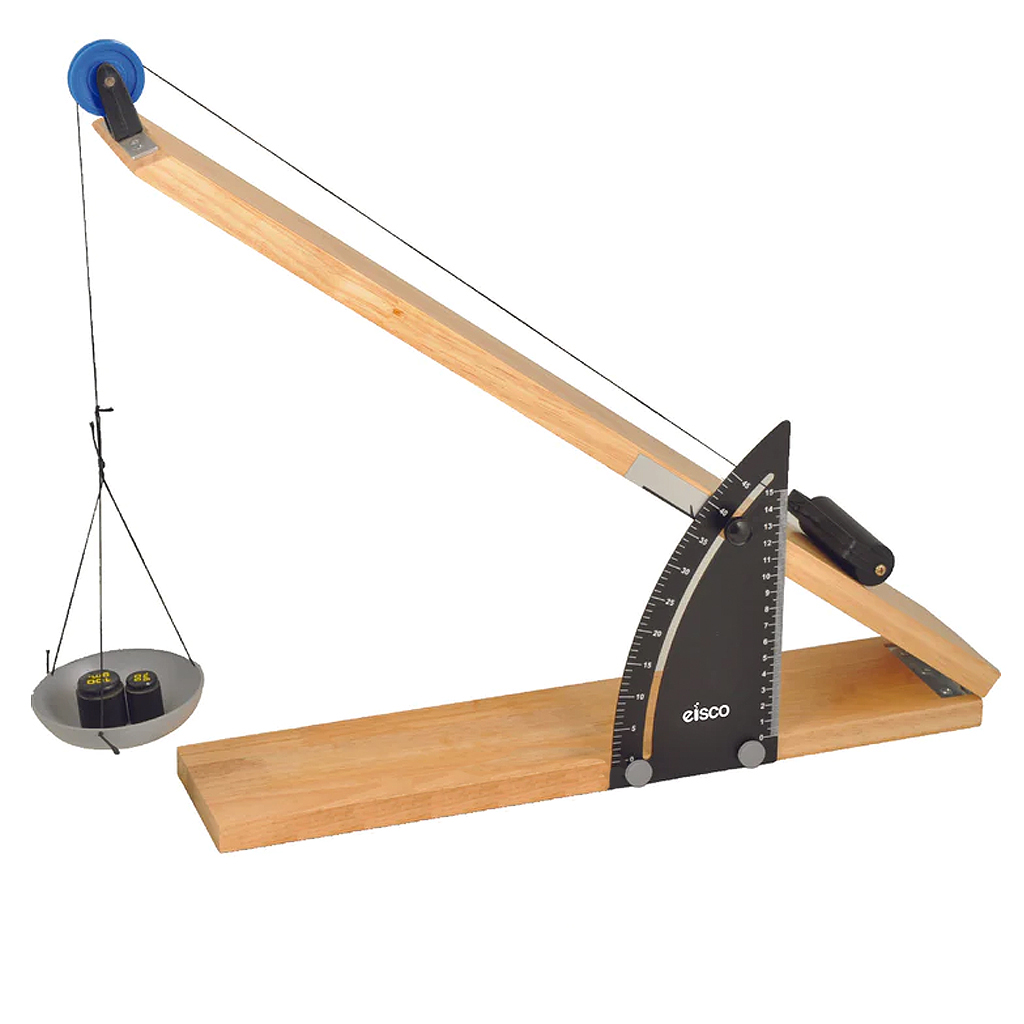
• This Inclined Plane demonstrates Newtons 2nd Law for forces parallel and perpendicular to the incline.
• Comprises a 600 x 75mm teak wood rectangular surface hinged at one end with in-built protractor for measuring angle of inclination.
• Adjustable pulley, roller and pan supplied.
• No weights supplied.
• (Note: Model may vary)
In stock (can be backordered)
INCLINED PLANE
• This Inclined Plane demonstrates Newtons 2nd Law for forces parallel and perpendicular to the incline.
• Comprises a 600 x 75mm teak wood rectangular surface hinged at one end with in-built protractor for measuring angle of inclination.
• Adjustable pulley, roller and pan supplied.
• No weights supplied.
• (Note: Model may vary)
(Wikipedia excerpt: ...".. also known as a ramp, is a flat supporting surface tilted at an angle from the vertical direction, with one end higher than the other, used as an aid for raising or lowering a load.[1][2][3] The inclined plane is one of the six classical simple machines defined by Renaissance scientists. Inclined planes are used to move heavy loads over vertical obstacles. Examples vary from a ramp used to load goods into a truck, to a person walking up a pedestrian ramp, to an automobile or railroad train climbing a grade.[3]
Moving an object up an inclined plane requires less force than lifting it straight up, at a cost of an increase in the distance moved.[4] The mechanical advantage of an inclined plane, the factor by which the force is reduced, is equal to the ratio of the length of the sloped surface to the height it spans. Owing to conservation of energy, the same amount of mechanical energy (work) is required to lift a given object by a given vertical distance, disregarding losses from friction, but the inclined plane allows the same work to be done with a smaller force exerted over a greater distance.[5][6]
The angle of friction,[7] also sometimes called the angle of repose,[8] is the maximum angle at which a load can rest motionless on an inclined plane due to friction without sliding down. This angle is equal to the arctangent of the coefficient of static friction μs between the surfaces.[8])...")
You may also like…
-

NEWTONS APPARATUS: Variety
Price range: $ 21.50 through $ 88.50 excl. GST Add to Cart This product has multiple variants. The options may be chosen on the product page